Vacuum Stress in Pets: Calm Training & Home Setup
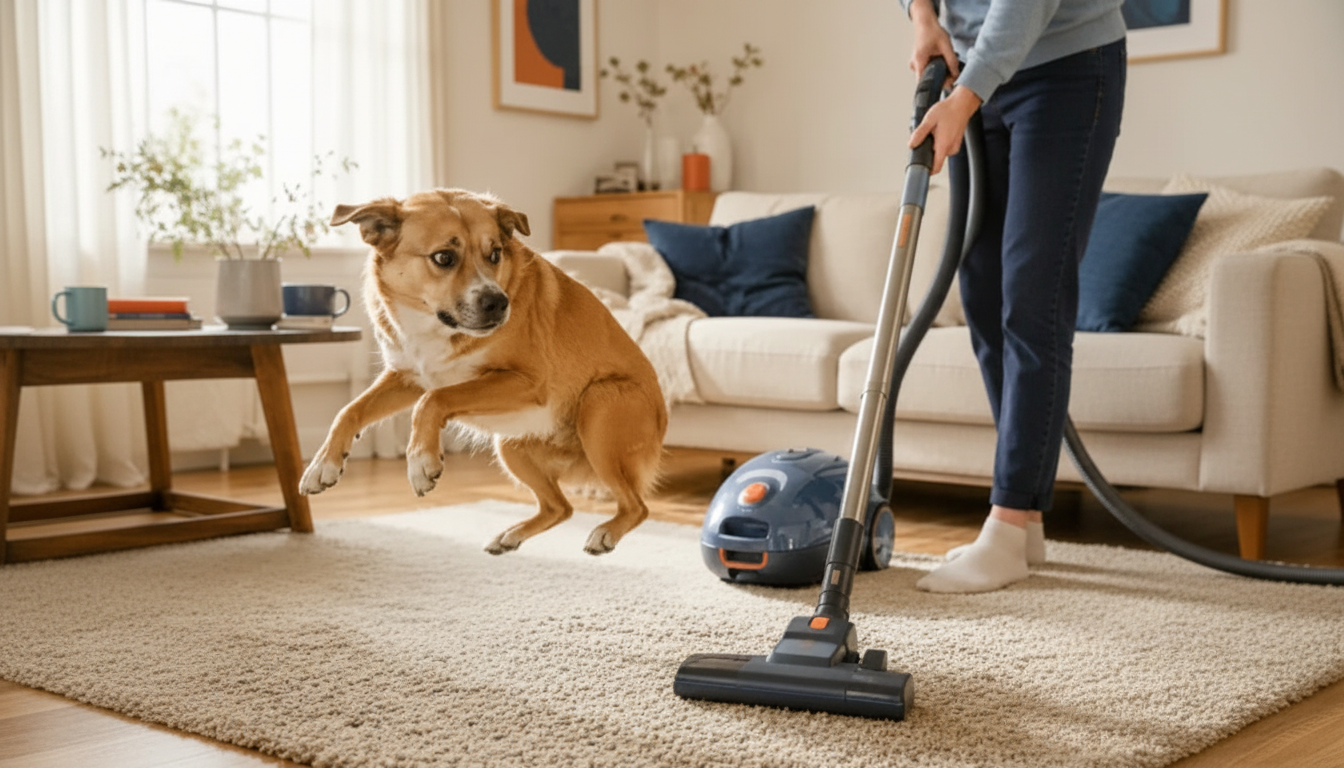
What vacuum stress looks like (and why it happens)
Some pets react to a vacuum the way they’d react to a sudden intruder: they run, bark, freeze, or try to make it “go away.” The first step is recognizing that these behaviors are usually rooted in fear or over-arousal, not stubbornness.
Common signs of vacuum stress include panting, trembling, a tucked tail, pinned ears, hiding, pacing, barking, growling, swatting or charging, drooling, or attempts to escape. Cats may bolt under furniture, while dogs may fixate, lunge, or herd the vacuum as it moves.
Vacuums combine several triggers at once: loud noise, floor vibration, quick motion, unpredictable direction changes, and strong airflow. For some pets, that mix feels threatening or simply too intense to process calmly. Puppies and kittens without early noise exposure, anxious rescues, noise-phobic pets, and some herding breeds (who are sensitive to fast-moving objects) can be especially reactive. For a deeper overview of behavior basics, the American Veterinary Medical Association (AVMA) animal behavior resources are a helpful starting point.
Set up the home so your pet has control and distance
Before training even begins, change the environment so vacuum time becomes predictable and avoidable. Fear often reduces faster when a pet knows they can leave the situation.
Create a reliable “quiet zone”
Pick a room farthest from where you’ll vacuum. Set it up with water, familiar bedding, and a long-lasting chew or food puzzle. This becomes a consistent “you’re safe here” location rather than a last-minute scramble.
Add sound buffering
Close doors, run a fan or white-noise machine, or play steady calm music to soften sharp vacuum sounds. Reducing the peak noise can prevent the first spike of panic.
Use visual barriers if needed
If your pet reacts to the sight of the vacuum moving, block the view with a baby gate, a closed door, or curtains. Many pets handle sound better when they don’t also have to track the vacuum’s motion.
Avoid chasing a hiding pet
If your pet retreats, let them. Blocking escape routes or pulling them out of hiding tends to confirm that the vacuum is dangerous and that they’re not in control.
A gradual training plan (desensitization + positive pairing)
The goal is simple: teach “vacuum predicts good things” without overwhelming your pet. Training works best in brief sessions where your pet stays below their stress threshold and can still eat, play, and think.
Step-by-step progression
7-day progression (adjust pace to your pet)
| Day | Vacuum setup | Pet distance | Reward plan | Success sign |
|---|---|---|---|---|
| 1 | Vacuum parked, off | Across the room | Treats for calm looks/sniffs | Approaches voluntarily or ignores |
| 2 | Vacuum moved slightly, off | Across the room | Treat after each small movement | No startle; stays loose |
| 3 | Vacuum in doorway, off | In safe zone with door open | Food puzzle while vacuum visible | Eats normally, relaxed posture |
| 4 | Vacuum on in another room (1–3 sec) | Safe zone | Treat stream during sound | Takes treats; no bolting |
| 5 | Vacuum on (5–10 sec), farther away | Safe zone | High-value treats/chew | Settles quickly after sound |
| 6 | Vacuum on, brief pass in hallway | Behind gate/door | Treats + praise for calm | Minimal barking; recovery fast |
| 7 | Normal vacuuming in short blocks | Safe zone or relaxed nearby | Reward breaks between blocks | Can rest or engage with enrichment |
What to do during vacuuming (reduce intensity in real time)
Habits to avoid that can worsen fear
Extra calming supports for noise-sensitive pets
- Scent and comfort: Familiar bedding, a covered crate (only if crate-trained), or a snug blanket can help some pets settle.
- Sound management: White noise, steady music, and closed windows can reduce layered noise that stacks stress.
- Training cues: Teach a mat/bed cue away from the vacuum path, reward it with the vacuum off, then gradually add sound.
- When fear is extreme: Talk with a veterinarian about behavior medication or situational aids. The ASPCA’s training and behavior guidance also supports reward-based methods that can be paired with professional help.
A structured approach for ongoing progress
Guided support for building calmer vacuum routines
Helping Pets Handle Vacuum Stress focuses on practical at-home routines: setting up a safe retreat, building positive associations, and measuring progress in small, repeatable steps.
For homes where overall stress levels run high, calmer communication and routines can help everyone (including pets) recover faster after loud or chaotic moments. Some families pair pet-focused training with general household tools like the Conflict-Resolution Workbook for Couples to reduce tension and keep routines consistent.
FAQ
Why does my dog bark or attack the vacuum?
Many dogs react to the vacuum’s loud noise and fast movement as a threat or as something “prey-like” to chase away. Add distance, provide a safe zone, and use gradual training so the vacuum predicts rewards instead of stress.
Should a fearful pet be forced to stay near the vacuum to get used to it?
No—forcing close exposure can backfire and increase fear. Controlled, gradual practice that allows retreat is more effective and helps your pet stay relaxed enough to learn.
How long does it take for a pet to get used to vacuuming?
It varies from days to weeks depending on sensitivity and how consistent training is. Progress looks like taking treats during brief vacuum sounds, choosing to stay nearby, and recovering quickly after the vacuum turns off.










Leave a comment