Cat Body Language Cheat Sheet: Tails, Ears, Meows
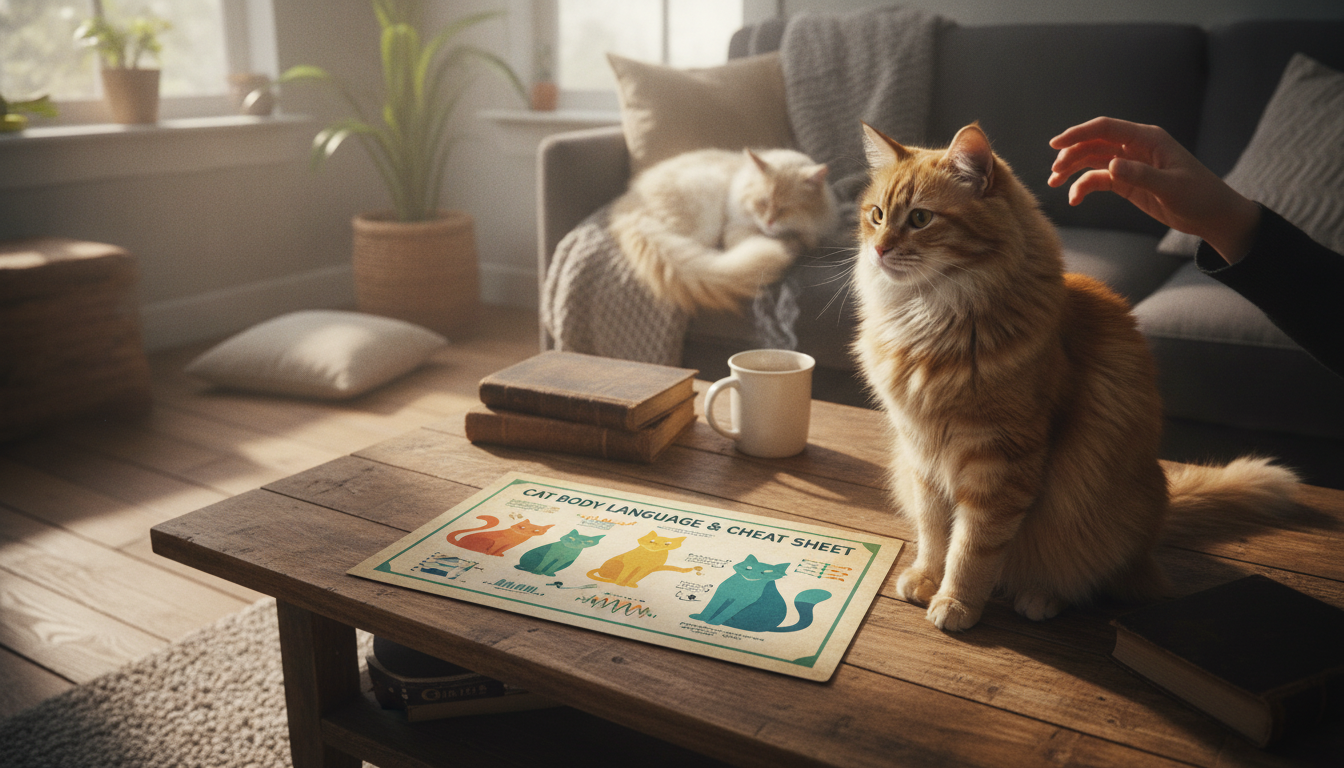
Cat Body Language & Behavior Cheat Sheet: A Printable Guide to Feline Signals, Postures, and Meows
Cats communicate constantly—just rarely in ways humans learned in school. A quick-reference cheat sheet helps turn confusing moments (sudden zoomies, a flicking tail, a “mrrp” at the door) into understandable signals. Use this guide to read common postures, facial cues, tail and ear positions, vocalizations, and context clues so daily interactions feel calmer, safer, and more connected. For more guidance, see How to Read Cat Body Language and Emotions.
How cats communicate: the big picture
Cat communication is best read like a “bundle,” not a single clue. Posture, face, tail, voice, and the situation work together. A tail flick might mean playful focus during a wand-toy session, but the same flick during petting can be a clear “that’s enough.” For further reading, see Understanding Cat Behavior and Feline Language.
- Combine signals: posture + face + tail + voice + context. One cue alone can be misleading.
- Expect flexibility: cats adjust their signals based on familiarity, environment, and past experiences.
- Watch the baseline: notice what’s normal for your cat—energy level, greeting style, and tolerance for touch.
- Use observation windows: before interaction (approach), during (handling), and after (walk-off, grooming, hiding) to judge comfort.
For additional behavior basics and humane handling guidance, reputable references include the American Association of Feline Practitioners (AAFP) Cat Friendly resources and the ASPCA cat behavior library.
Body posture signals: relaxed, alert, stressed, defensive
Relaxed/comfortable
A relaxed cat looks “loose”: soft muscles, easy breathing, casual stretching, or a calm loaf with paws tucked. Weight may rest on one hip, and movements are unhurried.
Alert/curious
Alert cats often shift weight forward, hold still, and track sounds with their ears. Many pause to evaluate before approaching—this isn’t rejection; it’s information-gathering.
Stressed/uncertain
Stress often shows up as a low crouch, tense muscles, freezing, hesitant steps, and frequent scanning. These cats usually prefer distance and choice over forced interaction.
Defensive/fearful
A defensive cat may arch the back, puff the fur, turn sideways, back away, hiss, spit, or swat. These are distance-increasing signals—space is the kindest response.
Overstimulated
Overstimulation can look like sudden tail lashing, twitching skin, rapid head turns, or a quick “snap” from enjoying petting to biting. The best strategy is stopping early—before it escalates.
Tail language: what the tail is “saying” right now
The tail is one of the fastest changing “mood meters” on a cat’s body. Check speed and stiffness as much as position.
- Upright tail (often with a hook at the tip): friendly greeting, social confidence, interest in interaction.
- Slow, gentle swish: thinking/deciding; give space and avoid sudden touch if attention is intense.
- Fast thumping or whipping: agitation or overstimulation; stop petting, reduce noise, increase distance.
- Puffed tail: fear or high arousal; remove stressors and provide a safe retreat route.
- Low or tucked tail: insecurity, discomfort, or fear; avoid cornering and keep routines calm and predictable.
| Tail cue | Common meaning | Best response |
|---|---|---|
| Upright, relaxed | Friendly/approachable | Greet softly; offer hand for a sniff; let the cat initiate contact |
| Tip twitching | High focus or mild irritation | Pause petting; reduce stimulation; watch ears/eyes for escalation |
| Fast lashing | Overstimulated or annoyed | Stop handling; give space; redirect with a toy at a distance |
| Tucked/low | Fear or discomfort | Avoid looming; offer hiding spot; use slow movements and quiet voice |
| Puffed | Scared or startled | Increase distance; remove trigger if possible; do not chase or pick up |
Ears, eyes, whiskers, and mouth: the face tells the truth
When tail and posture are “mixed,” facial cues often clarify what’s going on.
- Ears forward and relaxed: interest and comfort; with soft eyes, it usually signals friendliness.
- Ears sideways (“airplane ears”): uncertainty or irritation; pause interaction and offer choice.
- Ears pinned back: fear/defensiveness; increase distance and avoid reaching over the head.
- Slow blink: calm, affiliative signal; returning a slow blink can reduce tension.
- Dilated pupils: fear, excitement, play arousal, or pain—use the situation to interpret correctly.
- Whiskers forward: engagement/hunting/play focus; whiskers pulled back: stress or defensive readiness.
- Lip licking, yawning, head-turning: can be calming signals during tension.
For deeper health-and-behavior context (including when to call a veterinarian), the Cornell Feline Health Center behavior resources are a helpful reference.
Meows and other sounds: interpreting vocalizations with context
Common scenarios and what your cat likely needs
Using a printable cheat sheet at home (and making progress fast)
Printable Cat Communication Guide: quick reference for everyday life
If you want a ready-to-print version for fast look-ups during petting, play, introductions, or new environments, the Cat Body Language & Behavior Cheat Sheet | Printable Cat Communication Guide | Learn Feline Signals, Postures & Meows is designed to keep common cues and best responses in one place.
More printable guides (also in stock)
- Conflict-Resolution Workbook for Couples | Printable Relationship Communication eBook | Improve Listening, Resolve Arguments, Rebuild Trust
- Personal Finance Made Easy Ebook – Budgeting, Saving, Investing & Debt Management Guide for Financial Freedom
FAQ
Why does a cat purr while acting tense or hiding?
Purring can mean comfort, but it can also be a self-soothing response during stress or pain. Check posture, appetite, breathing, and whether the behavior is new; if changes persist or other symptoms appear, contact a veterinarian.
Is a belly-up cat asking for belly rubs?
Often it’s a trust display, not a touch invitation, and some cats will defend the belly reflexively. Try brief chin or cheek pets instead, watch for tail flicks or tense paws, and stop at the first sign of rising arousal.
What does it mean when a cat’s tail keeps flicking during petting?
Tail flicking during petting commonly signals increasing arousal or irritation and can be an early warning before a swat or bite. Pause petting, reduce intensity, switch to a preferred area (often cheeks), or end the session to respect your cat’s threshold.











Leave a comment